Daring Greatly vs. The Gifts of Imperfection: Which Brené Brown Book Should You Read First?
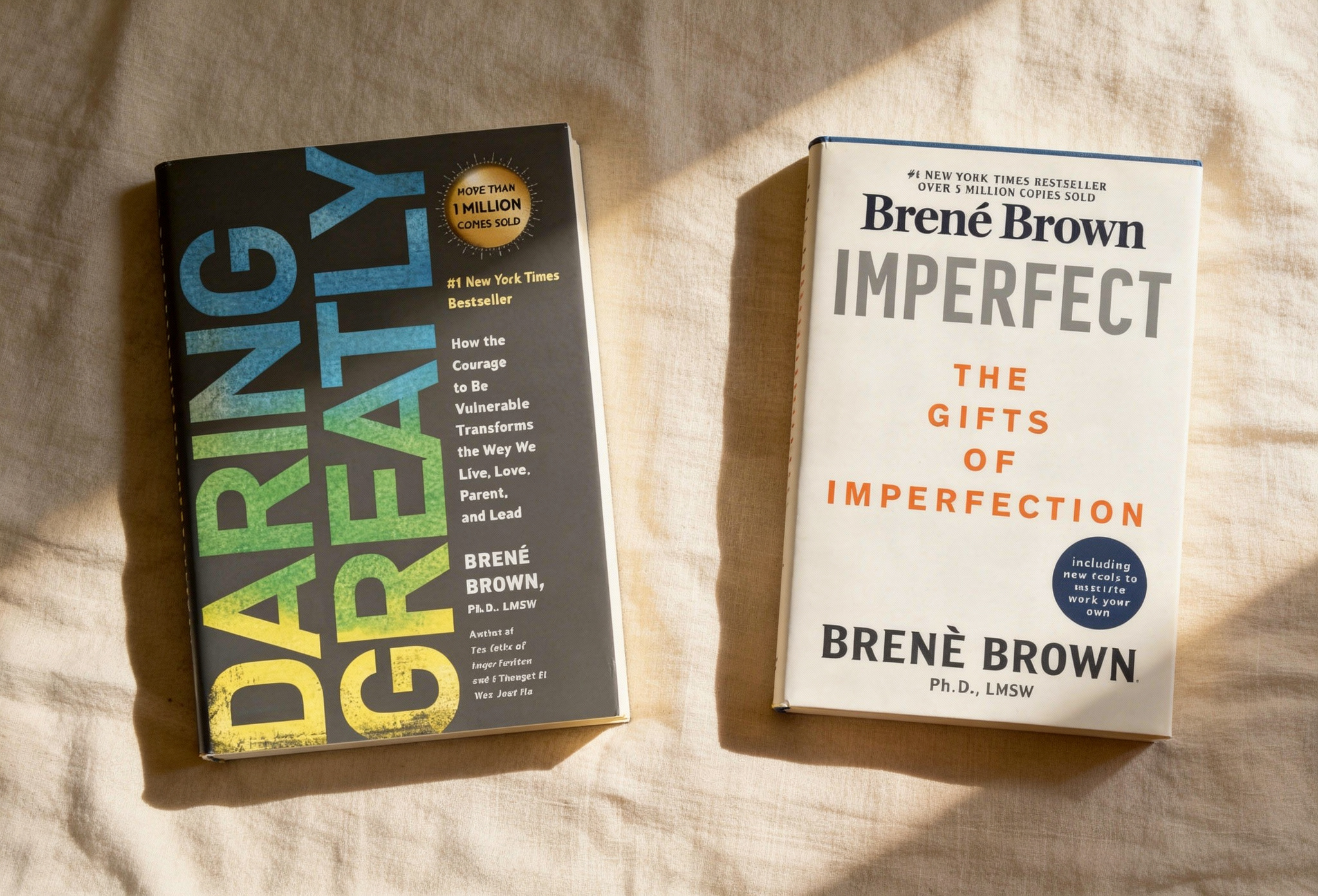
The question everyone asks about Brené Brown
If you've spent any time in women's reading communities, therapy waiting rooms, or group chats where someone has just been to a self-development event, you've heard about Brené Brown. You may have watched her TED talk — one of the most-viewed in history. You may have been told you 'must' read her.
And then you've faced the question: which book? Daring Greatly (2012) and The Gifts of Imperfection (2010) are the two most recommended. They are both about vulnerability and wholehearted living. They cover overlapping ground. People recommend both without always explaining why there are two, or what distinguishes them.
We read both to give you a clear answer. Here is what each book does, where they are the same, where they genuinely differ, and — most usefully — which one is right for where you are right now.
DG = Daring Greatly GI = The Gifts of Imperfection
The shared foundation — what both books are built on
Both books emerge from the same body of research. Brown spent years studying shame and vulnerability through qualitative interviews. Her central finding: the people who reported the most meaningful, connected lives — she calls them 'wholehearted' — had one thing in common. They had made peace with imperfection. Not achieved perfection. Made peace with not having it.
Everything else in both books flows from this finding. Shame drives us to hide our imperfections. Vulnerability is the willingness to be seen anyway. Wholehearted living is what becomes possible when you choose vulnerability over the armour of perfectionism.
The research is the same. The application differs.
Where the books genuinely differ — the 5 key distinctions
1. They differ: Scale and focus
GI — The Gifts of Imperfection: Personal and intimate. Organised around ten 'guideposts' for wholehearted living — creativity, gratitude, play, rest, authenticity, meaningful work, and others. It reads like a gentle, structured invitation to examine your own life. Each guidepost includes both a practice to cultivate and a barrier to let go of. The scope is your interior world.
DG — Daring Greatly: Broader and more outward-facing. It extends vulnerability into systems: families, schools, workplaces, leadership, parenting. The question is not just 'how do I live more wholeheartedly?' but 'how do we build cultures — at home and at work — that make vulnerability possible rather than punishing it?' The scope is you in the world.
2. They differ: The central metaphor
GI: The Gifts of Imperfection takes its organising image from the idea that imperfection is not a flaw but a gift — that the cracks are where connection happens, where creativity lives, where compassion becomes possible. The tone is warm, quiet, permission-giving.
DG: Daring Greatly takes its title from Theodore Roosevelt's 'Man in the Arena' speech — the person who dares greatly, who shows up and is vulnerable to failure and criticism, is more alive than the critic in the stands. The tone is bolder, more confrontational with the armour we build.
3. They differ: Shame: how much, and how
GI: Introduces shame and mentions shame resilience but does not make it the book's central subject. Shame is one barrier among several to wholehearted living.
DG: Goes deep into shame — how it works, what triggers it, how it differs between men and women, what shame resilience looks like in practice. If you want to understand your own shame responses and where they come from, Daring Greatly is where that material lives.
4. They differ: Parenting and relationships
GI: Touches on relationships as one of the ten guideposts but does not dedicate significant space to parenting or leadership.
DG: Has substantial chapters on parenting and on vulnerability in the workplace. If you are raising children or leading a team and wondering how to apply Brown's ideas in those specific contexts, the material is here and it is specific.
5. They differ: Practical tools
GI: More practice-oriented. Each guidepost includes specific things to cultivate and specific things to release — it functions partly as a workbook, inviting you to examine each area of your life. More actionable on a day-to-day basis.
DG: More conceptual and analytical. Brown builds frameworks — the vulnerability shield, the shame triggers, the wholehearted parenting manifesto — that give you language and structure rather than specific daily practices.
Where both books are the same — the 4 core shared ideas
1. Both books: Vulnerability is not weakness — it is the only path to connection
Both books make this argument with equal force. The armour we build to protect ourselves from vulnerability — perfectionism, busyness, numbing, cynicism — also cuts us off from love, belonging, joy, and creativity. You cannot selectively numb difficult emotions without also numbing the good ones.
The willingness to be seen — imperfect, uncertain, emotionally present — is the prerequisite for genuine connection. There is no shortcut.
2. Both books: Perfectionism is not the same as striving for excellence
Both books make Brown's famous distinction: perfectionism is not about high standards. It is about earning worth through achievement and appearance. It is other-focused — driven by the question 'what will people think?' Excellence is self-focused — driven by the question 'am I living up to my own values?'
Perfectionism is a defence mechanism, not a quality standard. It protects against shame and judgment by trying to be beyond criticism. It doesn't work — because critics exist regardless — and it costs everything it claims to protect.
3. Both books: Belonging requires showing up as you actually are
Both books return to Brown's most personally resonant finding: belonging is not the same as fitting in. Fitting in requires changing yourself to be accepted. Belonging requires being accepted as you are — and it can only happen if you show up as you actually are.
The painful corollary: performing a version of yourself to gain acceptance gives you the experience of being accepted, but not the experience of belonging. Because the version that was accepted is not you. The hunger remains.
4. Both books: Joy requires the capacity to tolerate vulnerability
One of Brown's most counterintuitive research findings, present in both books: the people who experience the most joy are also the people most willing to be vulnerable — because joy itself is vulnerable. Loving someone is vulnerable. Being happy is vulnerable. The impulse to 'dress rehearse tragedy' — to undercut moments of happiness by imagining what could go wrong — is a pre-emptive defence against the vulnerability of caring.
Both books argue: let the joy be real. The cost of defending against vulnerability is the loss of the thing you were trying to protect.
Which book should you read first?
Read The Gifts of Imperfection first if you are at a personal, inward turning point — examining your own life, questioning whether you are living in alignment with what actually matters, looking for a gentle but honest framework for change. If the question is 'how do I live better?' — this is the book.
Read this if: you want a structured, personal, practice-oriented guide to wholehearted living with specific things to cultivate and release in each area of your life.
Read Daring Greatly first if you are navigating a specific challenge in a relationship, parenting situation, or professional context — or if shame is a word that resonates and you want to understand your own responses to it more deeply. If the question is 'how do I show up better in the world?' — this is the book.
Read this if: you want to understand shame mechanics, vulnerability in systems, or how to parent or lead in a way that makes space for imperfection rather than punishing it.
Read both if you want the complete picture. They are better together than either alone — Gifts provides the personal foundation, Daring Greatly shows how to build outward from it. Many readers find that one lands more deeply depending on their life circumstances at the time of reading, and then return to the other a year or two later to find it has become more relevant.
A note on Brown's other books
Brown has written several books beyond these two: Braving the Wilderness (belonging and true community), Rising Strong (recovery from failure), Atlas of the Heart (emotions and language), and Dare to Lead (vulnerability in leadership). Each extends one thread from Daring Greatly or Gifts into a book-length treatment.
If you read both books here and want to go deeper on one aspect: shame and recovery → Rising Strong; belonging and standing alone → Braving the Wilderness; leadership → Dare to Lead. The two books in this comparison are the foundation. The others are extensions.