Breath by James Nestor: What Happened When I Changed How I Breathe for 30 Days
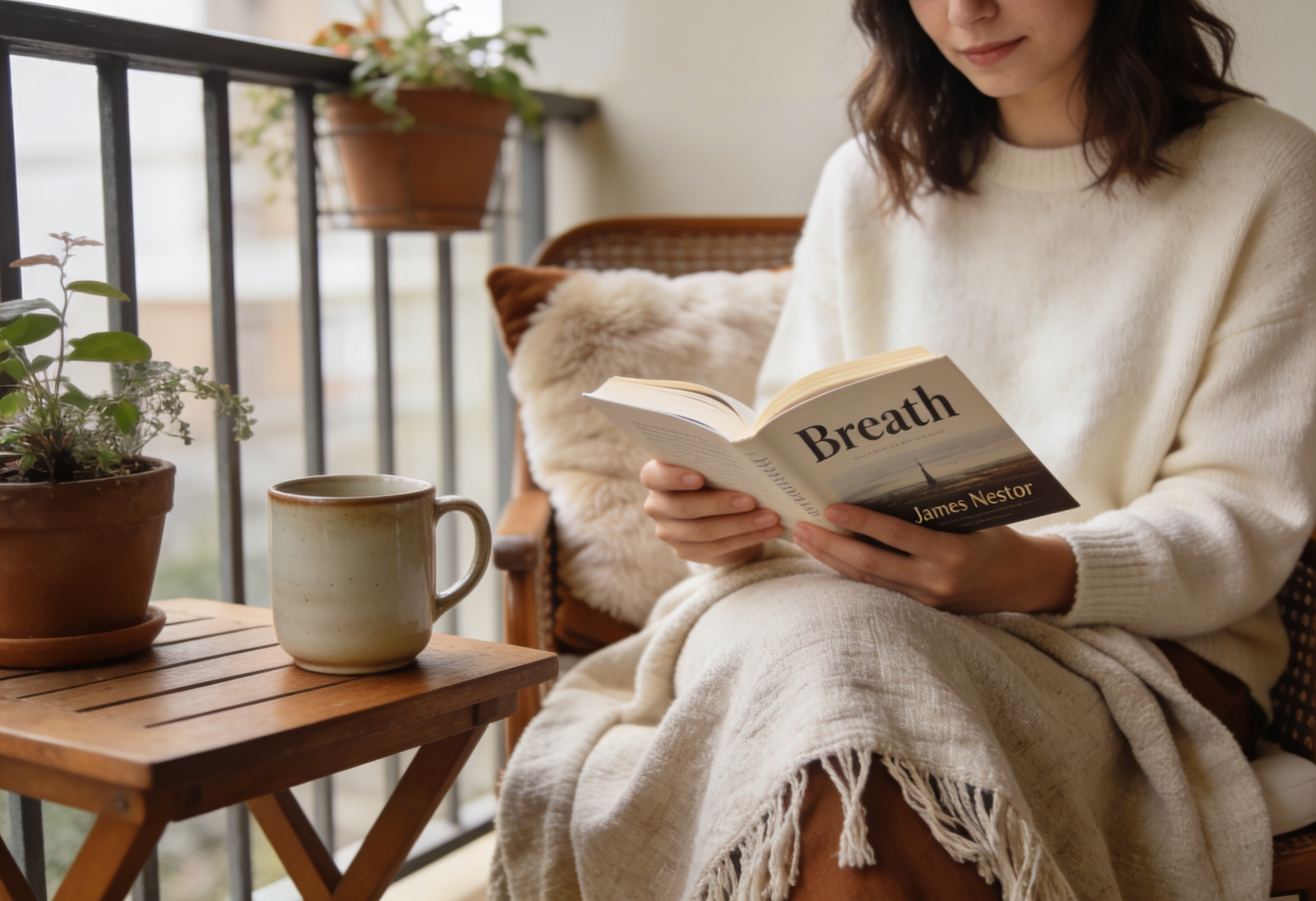
The thing you've been doing wrong your whole life
One of our readers — let's call her Sana, 38, a secondary school science teacher from Edinburgh — told us she picked up Breath after her third year of disrupted sleep and her second failed attempt at a mindfulness app.
"I knew how to meditate in theory," she said. "I just couldn't make myself do it. Breath was different because it wasn't asking me to change my mind. It was asking me to change something physical. Something I was already doing 23,000 times a day."
James Nestor's Breath, published in 2020, is a work of science journalism about one of the most overlooked aspects of human health: how we breathe. Not whether we breathe — obviously we do — but how: through which orifice, at what rate, at what depth, and with what pattern.
Nestor's central finding, backed by research spanning pulmonology, dentistry, anthropology, and sports science: most modern humans breathe badly. Too fast. Through the mouth. Too shallowly. And the consequences — for anxiety, sleep, energy, dental health, and immune function — are significant and largely reversible.
Sana spent 30 days changing how she breathed. Here is what the book taught her, and what actually changed.
The key ideas — before the diary
1. The nose is not optional — it's a sophisticated air-processing system
Nestor's opening argument: the nose is not an alternative entrance to the lungs. It is the correct one. Nasal breathing filters particles, humidifies air, regulates temperature, produces nitric oxide (which dilates blood vessels and kills pathogens), and slows the breath to a rate the body can actually use.
Mouth breathing bypasses all of this. It is faster, colder, drier, and — Nestor's research suggests — contributes to sleep apnoea, snoring, anxiety, dental crowding, and immune dysregulation. The mouth is for eating, speaking, and emergency breathing. The nose is for everything else.
Sana, day one: "I taped my mouth shut at night. This sounds extreme. Nestor recommends it, and the research supports it. I felt ridiculous. I also slept through the night for the first time in eight months. I'm not saying this will work for everyone. I'm saying it worked for me immediately and I had no idea it was possible."
2. Slow breathing changes the nervous system
Nestor cites research on breathing rate and autonomic nervous system regulation. The average modern human breathes at 15–20 breaths per minute. Optimal appears to be around 5.5 — roughly one breath every 11 seconds, or about 5.5 seconds in and 5.5 seconds out.
At this rate, heart rate variability increases, the vagus nerve activates, cortisol drops, and the body shifts from sympathetic (fight-or-flight) to parasympathetic (rest-and-digest) dominance. This is not metaphor. It is measurable physiology — and it happens within minutes of the breathing change.
Why this matters for anxiety: Anxiety is partly a state of chronic sympathetic activation — the nervous system stuck in alert mode. Slow nasal breathing is one of the most direct, evidence-based interventions for shifting out of that state. It requires no equipment, no subscription, and no expertise. It requires only attention.
3. Carbon dioxide is not just waste — it regulates oxygen delivery
This is the idea that surprises most readers. We assume that more oxygen is always better, and that exhaling CO2 faster (hyperventilating) helps us breathe more effectively. Nestor's research shows the opposite.
Carbon dioxide is the trigger that tells the body to release oxygen from haemoglobin to the cells. When we breathe too fast and exhale too much CO2, the body actually receives less oxygen at the cellular level, not more — despite more air moving through. Slow breathing raises CO2 slightly, which improves oxygen delivery throughout the body.
The counter-intuitive instruction: If you feel anxious and short of breath, the impulse is to breathe faster and deeper. This makes it worse. Slowing the breath — even when it feels uncomfortable — is what actually helps. The discomfort is CO2 tolerance adjusting. It passes.
4. Breath-holding builds CO2 tolerance and calm
Nestor explores the Buteyko method and free-diving training, both of which involve deliberate breath-holding to raise CO2 tolerance. People with high CO2 tolerance — who can remain comfortable with lower oxygen levels — tend to have lower baseline anxiety, better sleep, and more stable energy.
The practices range from simple (a short pause after exhale) to demanding (prolonged breath holds). Even the simplest version — pausing for 3–5 seconds after each exhale — has measurable effects on nervous system regulation within days of consistent practice.
Sana, week two: "I started pausing after each exhale for a count of four. It felt strange at first — slightly anxious, which Nestor says is normal as the body adjusts. By day ten it felt natural. My resting heart rate dropped four beats per minute. I checked it three times because I didn't believe it."
5. Mouth breathing and dental health — the connection nobody talks about
One of Nestor's more surprising findings: chronic mouth breathing reshapes the face and jaw. In children, it narrows the palate and dental arch, creating the overcrowded teeth that orthodontists correct with braces. In adults, the changes are slower but present — narrowing airways, worsening sleep apnoea over time.
The research comes from dentistry and anthropology: ancient skulls almost universally show wide dental arches and straight teeth. Modern skulls, in populations that adopted soft processed foods and mouth breathing, show crowded, misaligned teeth — a phenomenon that barely existed before industrialisation.
The implication: Orthodontic crowding is not primarily genetic. It is developmental — driven by diet texture and breathing pattern. This doesn't help adults much directly, but it matters enormously for how we think about children's airway development, and it reframes what 'normal' dental development looks like.
6. Ancient breathing practices are now supported by modern research
Nestor visits practitioners of pranayama, Tummo, the Wim Hof method, and Sudarshan Kriya — breathing traditions from Hindu, Buddhist, and indigenous cultures that have existed for thousands of years. He finds, consistently, that modern research validates the claimed effects: reduced inflammation, improved immune function, altered states of consciousness, and measurable changes in autonomic nervous system function.
The conclusion is not mystical. It is biological: the breath is one of the most direct levers available for changing the state of the nervous system, and humans have known this for millennia. The science is catching up.
Sana: "I had always dismissed breathwork as woo. Nestor convinced me that dismissing it was the woo. The mechanisms are well understood. The effects are measurable. I was the one being unscientific."
The 30-day diary — what Sana actually did
Week 1 — Mouth tape and the basics
Day 1: Mouth tape at night. One piece of surgical tape across the centre of the lips — not sealing the mouth completely, just encouraging nasal breathing. Result: slept through the night. Woke with dry mouth instead of parched throat. Energy better than usual.
Days 2–7: Established nasal breathing during the day. Noticed how often she switched to mouth breathing during exercise, stress, and concentration. Began slowing the breath consciously during moments of anxiety — five counts in, five counts out. Found it worked within two minutes, reliably.
Week 2 — Slow breathing and the exhale pause
Day 8: Added the exhale pause — 3–4 second hold after each out-breath during the day. Initial mild discomfort (normal, per Nestor). By day 10: resting heart rate measurably lower. Sleep tracking app showed improvement in deep sleep percentage.
Days 11–14: Began 5-minute slow breathing practice in the morning — 5.5 seconds in, 5.5 out, no pause. This is Nestor's 'perfect breath' rate. Found it difficult to sustain for a full five minutes initially. By day 14: could do it without effort.
Week 3 — Breathing during exercise
Days 15–21: Applied nasal-only breathing during her daily 30-minute walk. First three days: uncomfortable, pace had to slow significantly. By day 18: had adjusted and pace recovered. Noticed post-walk anxiety relief was noticeably greater than before. Heart rate during walk was lower at the same perceived exertion.
Sana, day 19: "I've been walking the same route for two years. This week I noticed things I've never seen — a garden, a painted door, a cat that presumably sits there every day. I wasn't in my head. I was in the walk. I think slowing the breath slowed me in a way I didn't expect."
Week 4 — Integration and honest audit
Days 22–30: Consolidated practices. Mouth tape nightly. Morning 5-minute slow breathing. Nasal breathing during exercise. Exhale pause during stressful moments.
Honest results at day 30: sleep significantly improved (fewer wakings, better subjective quality). Anxiety measurably lower — she tracks this weekly and the score dropped by 30%. Resting heart rate down 4–5 beats. Energy more consistent through the afternoon.
What didn't change: snoring (her partner reports it's slightly better but not gone). Exercise performance (marginal improvement, not dramatic). The dental stuff is a long game — no changes expected in 30 days.
What stayed
Six months later, Sana still tapes her mouth at night. She still does five minutes of slow breathing most mornings. She breathes through her nose during exercise, mostly.
"The tape sounds like the weird part," she said. "It's the part that made the most difference fastest. I've recommended it to six people. Three of them have thanked me. The other three think I've joined a cult."
The anxiety improvement has held. Not eliminated — she has difficult weeks. But the baseline is lower, and she has a tool that works within minutes when the anxiety spikes. She didn't change her diet, her exercise, her medication, or her circumstances. She changed how she breathes.
"Nestor's argument is that we've outsourced one of the most powerful health interventions available — our own breath — to unconscious habit, and mostly got it wrong. I believe him now."