Atomic Habits by James Clear: 12 Key Ideas for Women Over 50 Who Are Ready to Change
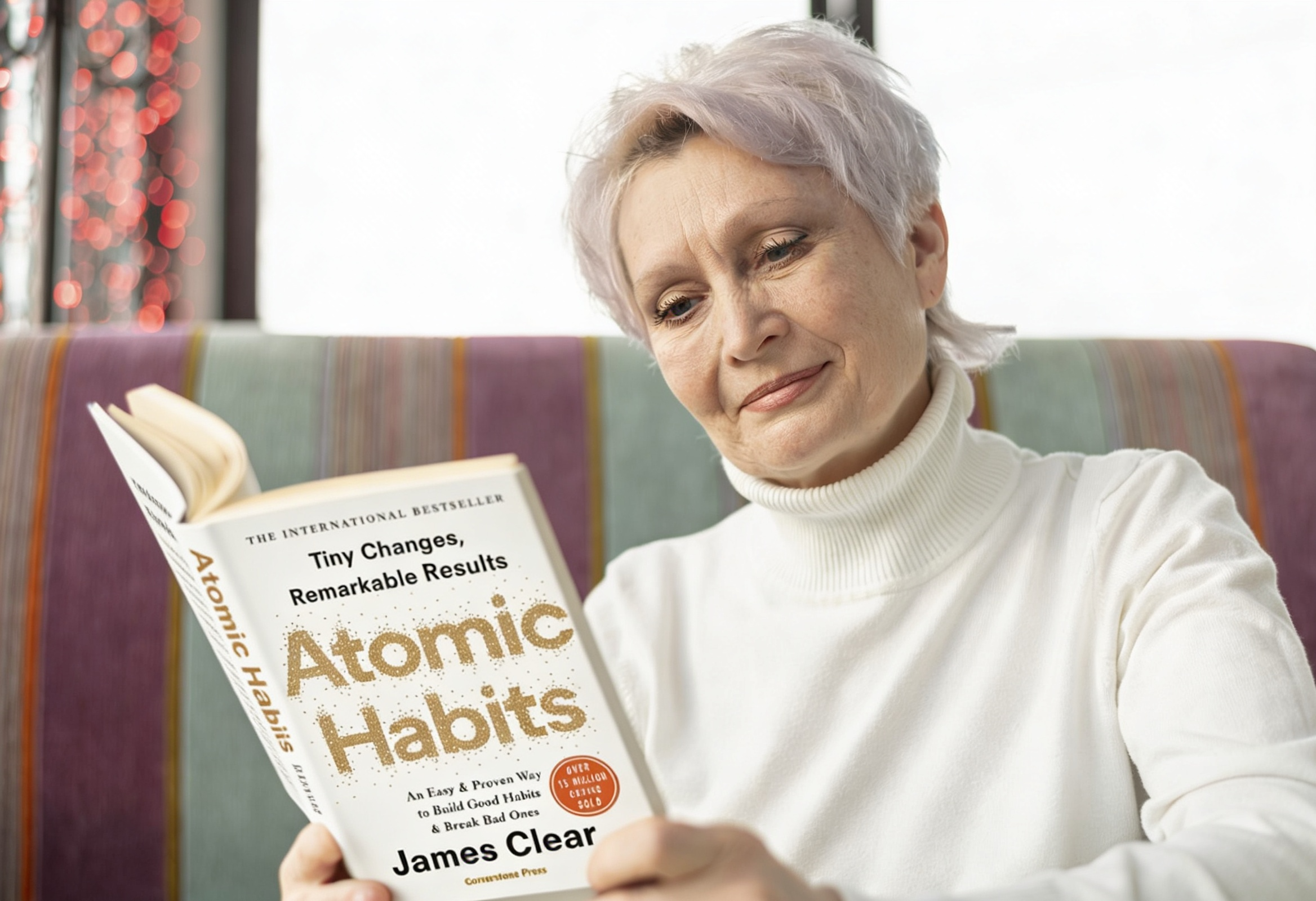
One of our readers — let's call her Margaret, 57, a recently retired teacher from Ohio — wrote to us last month. "I know exactly what I need to do," she said. "More movement, less scrolling at night, actually finishing the novel I started three years ago. I know it all. I just don't do it."
We hear this constantly. And what strikes us every time is how much wisdom is packed into that sentence. Margaret doesn't need more information. She doesn't need another goal. She needs a system.
That's exactly what James Clear's Atomic Habits delivers — and it has sold over 20 million copies for a reason. But here's what most summaries miss: this book was not written with a 55-year-old woman in mind. The examples skew young. The framing assumes you're building a career, not reconsidering one. The language of "leveling up" can feel foreign when you're in a life stage that's really about going deeper, not higher.
So we read it for you. Here are the 12 ideas that matter most — reframed for where you actually are right now.
Idea 1. Forget goals. Build systems.
Clear's opening provocation: the difference between the team that wins the championship and the team that loses isn't the goal. Both teams wanted to win. The difference is the system — the daily practices that make winning more or less likely.
For women 50+: You have set goals your entire life. You know how to want things. What this stage of life calls for is designing the daily environment that makes what you want inevitable — not motivating yourself to want it harder.
Idea 2. The 1% rule: tiny changes, remarkable results
If you improve by just 1% every day, you'll be 37 times better by the end of a year. The math is compelling. But what's more compelling for midlife women is this: you don't need 40 years for compound progress to show up. Six months of a 1% daily improvement in sleep, movement, or stress response produces clinically measurable change in your body and cognition.
You have more time than you think. And you have less tolerance for dramatic reinventions that collapse after three weeks — which is exactly why this approach works.
Idea 3. Identity-based habits: who do you want to be?
This is the most important idea in the book. Clear argues that lasting habits don't start with outcomes ("I want to lose 10 pounds") or processes ("I'll go to the gym three times a week"). They start with identity: "I am a person who moves her body every day."
Every action you take is a vote for the kind of person you believe yourself to be. When you cast enough votes, the identity becomes real.
For women 50+: Many women at this stage are in the middle of a quiet identity renegotiation. Children have grown. Careers are shifting. The question "Who am I now?" is not existential crisis — it's raw material. The answer you choose becomes the foundation your habits are built on.
Idea 4. The habit loop: cue, craving, response, reward
Every habit — good or bad — follows the same four-stage loop. Something triggers it (cue). You feel a pull toward it (craving). You perform the behavior (response). You receive something satisfying (reward). The loop runs automatically, which is why habits are so hard to break by willpower alone.
Understanding this is not just academic. When you recognize that the evening glass of wine isn't really about the wine — it's a response to the cue of "day is over" and the craving for decompression — you can design a different response to the same cue that still satisfies the underlying need.
Idea 5. Make it obvious: design your environment
The most effective way to change behavior is not to change your motivation. It's to change your environment so the right behavior becomes the default.
Three concrete examples: Place your walking shoes by the door, not in the closet. Put your book on your pillow, not your phone on your nightstand. Keep your water bottle on the kitchen counter where you'll see it at eye level, not stored in a cabinet.
You are not fighting laziness. You are engineering friction. The easier you make the right action, the more often it happens.
Idea 6. Habit stacking: attach new to existing
Clear's practical formula: "After I [CURRENT HABIT], I will [NEW HABIT]." After I pour my morning coffee, I will write three sentences in my journal. After I brush my teeth, I will do five minutes of stretching.
For women 50+: This is your secret advantage. By this point in life, you have deeply grooved daily rituals — morning routines, mealtimes, evening wind-downs — that run on autopilot. New habits attach most naturally to structures that already exist. You have more of those than a 25-year-old does.
Idea 7. Temptation bundling: make it attractive
Pair something you need to do with something you genuinely want to do. Only listen to your favorite podcast while walking. Only watch that series you love while folding laundry. Only call a friend you've been meaning to catch up with while doing something routine you'd otherwise rush through.
The brain learns to associate the obligation with the pleasure. Eventually, the walk becomes something you look forward to — because it's when you get to listen.
Idea 8. The two-minute rule: make it easy to start
Any new habit should take less than two minutes to begin. Not two minutes total — two minutes to start. "Read before bed" becomes "open the book." "Exercise every morning" becomes "put on my workout clothes."
For women 50+: This is especially important during perimenopause and menopause, when fatigue is real and unpredictable. Starting is the hardest part. A two-minute version of a habit on a difficult day is infinitely better than skipping it entirely — because it keeps the identity vote alive.
Idea 9. Reduce friction: make the right choice the easy choice
Every step between you and a behavior reduces the probability of doing it. Clear calls this "friction." The goal is to reduce friction for good habits and increase it for habits you want to stop.
Prepare your gym bag the night before. Pre-cut vegetables on Sunday. Delete the apps you mindlessly scroll at 11pm — or move them off your home screen so they require three extra taps. These are not tricks. They are environmental design.
Idea 10. Make it satisfying: reward matters now, not later
The brain prioritizes immediate feedback. A habit whose reward comes in three months — better health, more money, calmer relationships — is fighting an uphill battle against habits that feel good right now.
The solution is to attach an immediate reward to the behavior. A habit tracker is one of the best tools for this: the simple act of checking off a box gives immediate satisfaction. Not because it's childish — but because it works with how the brain actually learns.
Idea 11. Never miss twice
Missing once is an accident. Missing twice is the beginning of a new habit — the habit of missing.
For women 50+: This single idea may be the most liberating in the book. Many women at midlife carry a deep perfectionism — a sense that if they can't do something completely, they've failed. Clear's framework gives you permission to be imperfect and still succeed. One missed workout doesn't break your identity as someone who moves. Two consecutive misses starts to.
Idea 12. The plateau of latent potential
Clear describes what he calls the "Valley of Disappointment" — the gap between when you start a habit and when you can see results. Progress is happening beneath the surface. The ice cube is absorbing heat. But it's still frozen. Then, at exactly 32°F, it melts all at once.
Most people quit in the valley. They don't see results and assume nothing is working. What they don't know is that the results are accumulating invisibly, waiting for the threshold.
If you've ever felt like you're doing everything right and still not seeing change — you're probably in the valley. Keep going. The ice is melting.
One last thing
Margaret, our retired teacher, started small. One habit: a ten-minute walk after breakfast, every day. She didn't call it exercise. She called it "my morning time." Seven weeks later, she wrote again.
"I don't know what happened," she said. "I'm sleeping better. I finished four chapters of my book. I've been cooking real meals again. I didn't try to do any of those things. They just started happening."
She had changed her identity in one small area. And the rest of her life reorganized itself around it.
James Clear's system is not magic. It's just honest about how humans actually change — slowly, through small repeated actions, until the actions become who you are. That process is available to you at 50, at 60, at any age when you decide to begin.
Start with one habit. Make it tiny. Make it obvious. And cast your first vote for who you're becoming. When you're ready to go deeper, the same principles apply to every other area of life — including how you think about your own potential, which is exactly what Carol Dweck's work on explores next.