Thinning Hair After 50? 8 Solutions That Don't Involve Wigs
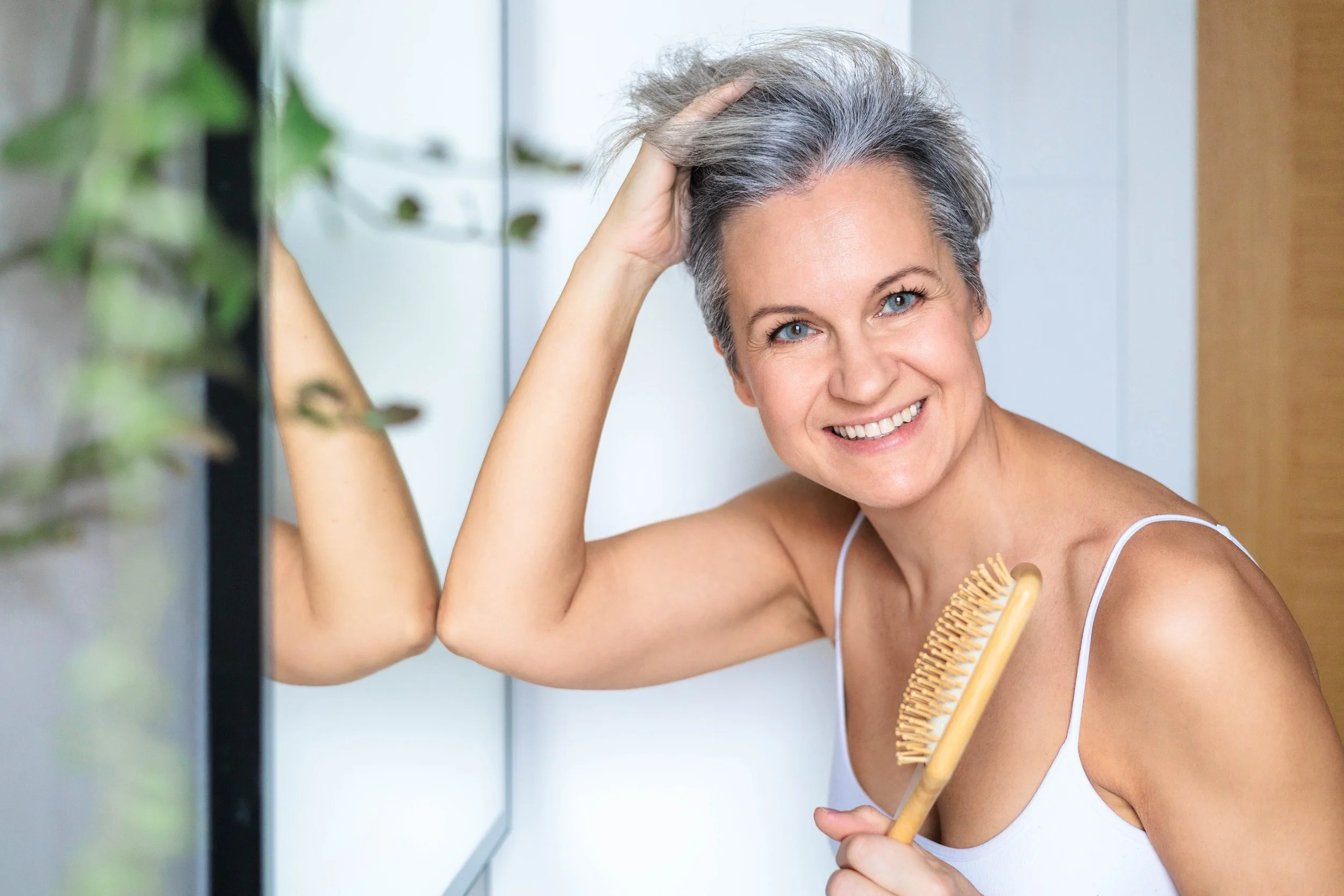
Hair thinning after 50 is one of the most consistently experienced and least openly discussed changes of midlife. Most women notice it — a wider parting, more hair on the brush, less volume in the ponytail, a scalp that shows more than it used to — and most women assume it is simply what happens and cannot be addressed without disguise.
Both assumptions deserve revision. Hair thinning after 50 is genuinely common — hormonal changes at menopause accelerate a process that was already occurring, and by their mid-50s most women have noticeably less hair than they did at 35. But most of it is more addressable than women expect. Not fully reversible in all cases, but addressable: there is a meaningful difference between the thinning that is ignored and the thinning that is actively managed.
The eight solutions below are ordered from the strongest medical evidence to the most cosmetically immediate. They are not mutually exclusive — most women with significant thinning use a combination of approaches. And they are all, without exception, more effective than the approach of covering the problem and hoping nobody notices.
Most hair thinning after 50 has an addressable component. Understanding the cause is the first step, because different causes have different solutions — and treating the wrong cause produces no result regardless of how consistently it's applied.
Understanding the cause — why it matters before the solutions
Hormonal: the most common cause after 50
Female-pattern hair loss (androgenetic alopecia in women) is the most common type of hair loss after menopause. It differs from male-pattern baldness in its presentation — women typically experience diffuse thinning across the crown rather than recession at the temples — and in its mechanism. Androgens (including testosterone, which increases relative to estrogen after menopause) miniaturise hair follicles over time, producing finer, shorter hairs until some follicles stop producing visible hair entirely. This process is gradual, progressive, and irreversible in the follicles that have been fully miniaturised — which is why earlier treatment produces better results.
Nutritional deficiencies: frequently missed
Iron deficiency (without necessarily being anaemic — ferritin, the iron storage protein, can be low while haemoglobin is normal) is one of the most common reversible causes of hair loss in women and is frequently missed because ferritin is not part of standard blood panels unless specifically requested. Low ferritin reduces the energy available to hair follicles, producing diffuse shedding that is indistinguishable from hormonal thinning without a blood test. Other nutritional contributors: vitamin B12 deficiency (common after 50, particularly in women on metformin or who follow plant-based diets), low zinc, and insufficient dietary protein.
Thyroid dysfunction: the imitator
Both underactive thyroid (hypothyroidism) and overactive thyroid (hyperthyroidism) cause diffuse hair loss. Hypothyroidism is more common in women over 50 and is also associated with fatigue, weight change, and cognitive slowing — symptoms that can be attributed to menopause and missed as a separate condition. A TSH blood test is part of any responsible hair loss investigation.
Traction and tension: the self-inflicted
Chronic traction — from tight ponytails, tight braids, or hair extensions — causes traction alopecia, which begins as thinning at the hairline and temples. If tension is released early enough, the follicles can recover. Long-term traction causes permanent follicle damage. Any woman noticing thinning specifically at the hairline or temples alongside a history of tight hairstyling should consider this as a contributing factor.
Stress and telogen effluvium
Significant physical or emotional stress — major illness, surgery, bereavement, crash dieting — can trigger telogen effluvium: a synchronised shift of many follicles into the resting (telogen) phase, followed by simultaneous shedding two to four months after the trigger. This produces sudden, dramatic shedding that is genuinely alarming but is typically self-limiting — the hair regrows within six to twelve months as follicles re-enter the growth phase. This type of shedding does not respond to minoxidil or nutritional supplementation; it resolves when the trigger is resolved.
8 solutions — from strongest evidence to most immediate
1. Identify and treat the underlying cause first
If thinning is new, significant, or sudden, a GP appointment with a request for a specific blood panel is the correct first response — before purchasing any product or supplement. The panel should include: ferritin (not just haemoglobin), full thyroid panel (TSH, free T4), B12, folate, zinc, and vitamin D. A dermatology referral for dermoscopy of the scalp can identify whether follicle miniaturisation (hormonal pattern loss) or other pathology is present.
Treating the wrong cause wastes time and money. Iron supplementation for genuinely iron-deficient hair loss can produce dramatic regrowth within three to six months — and produces no result in iron-replete women. The investigation is worth having before the solution.
2. Minoxidil: the strongest over-the-counter evidence
Minoxidil (sold as Regaine in the UK) is the only topical treatment with consistent clinical trial evidence for female-pattern hair loss. It prolongs the anagen (growth) phase of the hair cycle and has been shown in multiple randomised controlled trials to reduce shedding and produce modest regrowth in women with androgenetic alopecia.
The women's formulation is 2% minoxidil applied twice daily; a 5% foam formulation (licensed for men but used by women) is also available and may be more effective. Results take four to six months of consistent use to become visible — and the improvement is maintained only as long as treatment continues. Stopping minoxidil results in return to the previous rate of loss within six months. This is not a cure; it is a maintenance treatment. discussing minoxidil with your GP is worth doing before starting — they can confirm the diagnosis and monitor response.
3. Nutrition — iron and protein first, supplements second
If ferritin is below 70 micrograms per litre (a level at which follicles have adequate iron stores — lower than the standard 'normal' range of 13-150), iron supplementation produces real hair benefit. Ferrous sulfate (the standard GP prescription) or ferrous fumarate is better absorbed than many branded 'iron for hair' supplements. Take with vitamin C and away from tea, coffee, and dairy which inhibit absorption.
Protein adequacy matters for hair growth — the hair shaft is primarily keratin, a protein, and inadequate dietary protein reduces hair growth rate and strand thickness. the protein targets specifically relevant for women over 50 — 1.2-1.6g per kg body weight daily — are substantially higher than most women achieve, and the hair is one of the first systems to reflect dietary protein insufficiency.
Biotin is marketed extensively for hair growth. The evidence supports biotin supplementation for hair loss only in women with genuine biotin deficiency — which is uncommon outside of certain medical conditions. In biotin-replete women, supplementation produces no benefit. The widespread marketing of biotin for hair loss outpaces the evidence.
4. Scalp health: the foundation everything else builds on
The scalp is the skin from which every hair grows — its health directly affects follicle function. Scalp conditions that impair growth include seborrheic dermatitis, psoriasis, contact dermatitis from hair products, and folliculitis. Many women with thinning hair have an underlying scalp condition they've normalised as dandruff or sensitivity. the specific scalp conditions and how to address them covers this in detail — a healthy scalp is the prerequisite for healthy hair growth, and no topical treatment or supplement compensates for a compromised scalp environment.
Scalp massage — two to four minutes daily with fingertips applying moderate pressure — has emerging evidence for improving hair thickness, likely through mechanical stimulation of blood flow to the follicles. It is low-risk, costs nothing, and several small trials have shown measurable improvement in hair density with consistent daily practice over six months. It is also a useful daily ritual for noticing scalp condition changes early.
5. Cut changes that work with thinning hair
The cut is the most immediately effective and entirely free tool available for managing the appearance of thinning hair. Several specific cut changes produce significant visual improvement:
Shorter length reduces the weight of hair pulling down on already-fine strands — which makes hair lie flatter and emphasises thinning. Removing weight through a medium-length cut often produces more volume than keeping length. A long, thin ponytail emphasises how little hair there is; a structured bob at the same density looks deliberately chosen.
Layers distributed through the mid-lengths (not at the crown, which reduces volume at the top) create movement that reads as fullness. A flat, one-length cut on thinning hair lies flat; layered hair lifts and moves even with reduced density.
The fringe question: a fringe or curtain fringe covers the hairline and temple area — where thinning often appears first — while adding horizontal definition to the face. the cuts specifically designed for thinning mature hair include several with built-in fringe options for exactly this reason.
6. Volumising products — what actually works
The product category most marketed to women with thinning hair is also the one with the most misleading claims. Several distinctions worth making:
Volumising shampoos and conditioners that work: those containing proteins (wheat protein, keratin) which temporarily coat the hair shaft and increase its diameter. Products to avoid at the root: heavy conditioners, oils, and masks applied close to the scalp — these weigh hair down and worsen flatness. Condition from mid-lengths to ends only.
Dry shampoo is one of the most effective volume tools available — the powder particles add texture and lift at the root. Applied to the root area of dry hair and brushed through, it produces visible volume without product weight. Worth using even on days when oil is not the issue, purely for the texture it provides.
Root lift sprays and mousses applied to damp hair at the root before blow-drying can make a meaningful difference when combined with correct blow-dry technique (rough-drying with fingers first to create lift, then directing heat upward from underneath rather than downward). The technique often matters more than the product.
7. Hair fibres and concealers: the immediate cosmetic solution
Keratin hair fibres (Toppik, Nanogen, Hair Illusion) are fine protein-based fibres electrostatically charged to adhere to existing hair and fill in areas where scalp is visible. Applied to dry hair, they produce an immediate and dramatic visual improvement in apparent density — the exposed scalp becomes less visible and the area looks fuller. They shake out with shampooing and must be reapplied.
This is a cosmetic solution rather than a treatment — it addresses appearance, not the underlying loss. But for women who find their thinning significantly affecting their confidence in professional or social situations, the immediate effect of hair fibres is substantial. They do not interfere with other treatments and can be used alongside minoxidil, nutritional support, and any other approach.
Scalp-tinted dry shampoos (Batiste Colour, L'Oréal Magic Retouch for root concealment) provide a coloured powder that covers visible scalp through existing hair in the same principle, with less build-up of fibres and easier application at the parting line.
8. Prescription options: when to consider them
For women with confirmed androgenetic alopecia who have not responded to minoxidil or want a more aggressive approach, two prescription options exist in the UK:
Spironolactone: an anti-androgen medication that reduces the androgenic activity driving follicle miniaturisation. It is used off-label for female-pattern hair loss and has evidence from several studies showing reduced shedding and modest regrowth. It requires a GP or dermatology prescription and carries some side effects (potassium elevation, breast tenderness, menstrual irregularity in pre-menopausal women — less relevant for post-menopausal women). Not appropriate in pregnancy.
Finasteride: primarily used for male-pattern baldness, finasteride is occasionally prescribed off-label for post-menopausal women with androgenetic alopecia. The evidence for women is less extensive than for men. It is specifically contraindicated in women who are or could become pregnant (it causes birth defects). Requires dermatology consultation.
Low-level laser therapy (LLLT): devices including the Currentbody Scalp hair growth device and various professional laser caps have emerging evidence for stimulating follicle activity in androgenetic alopecia. The evidence is more limited than for minoxidil but is growing. LLLT devices are expensive (£200-600 for home-use devices) and require consistent use (several times per week, every week) for results.
What doesn't work — being specific
Most 'hair growth' supplements without a specific deficiency: biotin (addressed above), collagen supplements (no evidence for hair regrowth in replete individuals), branded 'hair, skin and nails' complexes (evidence for their combined formula is absent). These are not harmful, but the money is better directed toward investigation of actual deficiencies.
Caffeine shampoos marketed for hair growth: caffeine has evidence for stimulating hair follicle activity in vitro (in laboratory conditions) but the concentration of caffeine that reaches the follicle through a rinse-off shampoo product is far below the concentration used in laboratory studies. The evidence for caffeine shampoos producing meaningful hair regrowth in humans is not convincing. They are also not harmful — but not a substitute for the evidence-based approaches above.
Our weekly letter covers hair, beauty, and wellbeing for women over 50. Subscribe at femmementor.com.