The Capsule Wardrobe for Women Over 50: 25 Pieces That Always Work

The wardrobe is full. You know it's full because the rail is crowded, the shelves are stacked, and there are things at the back you haven't touched in two years. And yet most mornings you stand in front of it feeling that there is nothing to wear — nothing that goes together easily, nothing that suits the day you're actually having, nothing that looks like the version of yourself you want to project. The clothes exist. The outfit doesn't.
This is not a storage problem. More hangers won't solve it, and neither will another shopping trip. It is a system problem: a wardrobe that has accumulated rather than been designed, full of individual pieces that were each a reasonable decision and that together produce the feeling of having nothing.
The capsule wardrobe is the alternative system. Not minimalism as a philosophy — not the challenge of owning fewer than thirty items and photographing them against a white wall. A practical system: a considered set of pieces chosen to work together across multiple combinations, so that the decision that feels impossible at 7am becomes automatic. Twenty-five pieces, specifically chosen, will produce more usable outfits than a hundred pieces collected without system.
The 25 pieces below are specific. Each comes with what to look for, what to avoid, and why it earns its place. They assume a lifestyle that includes some professional or social context alongside casual daily life — adjust the proportions if your life is mostly one or the other.
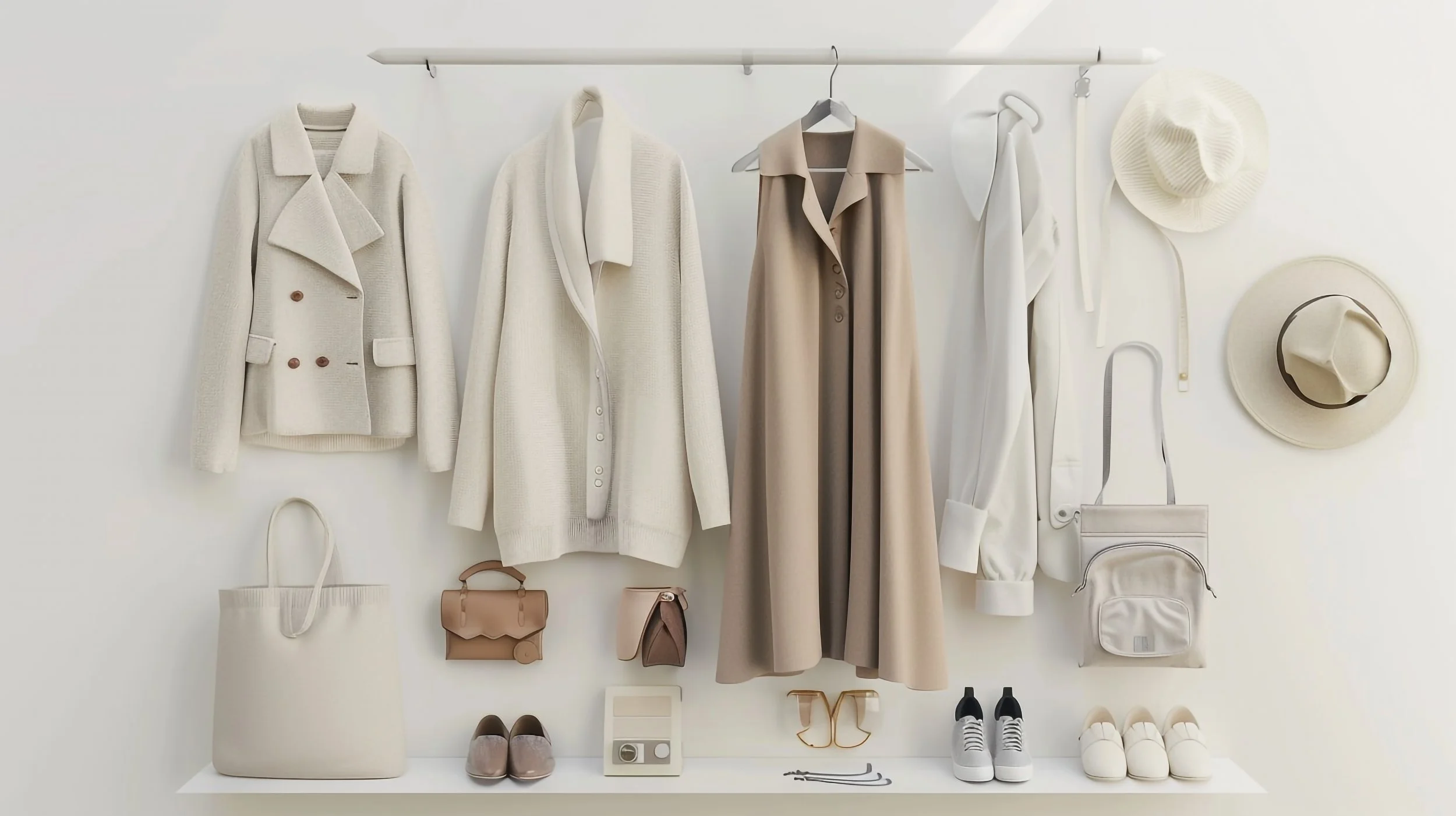
The capsule wardrobe is not about owning less. It is about owning intentionally — pieces chosen because they work with each other, not because each one worked in the shop.
Before the pieces: three decisions that determine everything
Your colour palette
The capsule works because everything goes with everything. This requires colour discipline. Choose two to three neutral base colours (black, navy, white, grey, cream, camel, tan — pick the ones your skin responds to best) and one to two accent colours that you genuinely wear and that work with your neutrals. Every piece in the capsule should sit within this palette.
The specific neutrals matter: navy and black don't always mix well; cream and pure white can clash. Choose your base colours together and check they work as a group before committing. The most versatile single base colour for most women's capsules is navy — it works with almost every other neutral and is more flattering on more skin tones than black.
Your life, not an aspirational version of it
A capsule built for the life you wish you had produces a wardrobe you never use. Before choosing pieces, spend five minutes being honest about where you actually go and what you actually do across a typical week. If your week is mostly casual with two or three professional occasions per month, the proportion of the capsule should reflect that — not the reverse. A capsule built around your real life solves the morning problem; one built around an imagined life compounds it.
Quality over quantity — specifically what that means
The capsule principle produces better results with fewer, better pieces. A cost-per-wear calculation makes this concrete: a £200 coat worn 150 times costs £1.33 per wear; a £60 coat that falls apart after 30 wears costs £2 per wear. For the category pieces — the coat, the trousers, the boots — the quality that makes them last and keep their shape through repeated wear is worth the investment. For accent pieces that may change with your preferences, a more moderate approach makes sense.
The 25 pieces — by category
TOPS — 5 pieces
Top 1 — White or ivory structured button-down shirt
The most versatile single piece in any capsule. Worn tucked into trousers for a professional context, half-tucked into jeans for a weekend, open over a fitted top, belted, or with the collar up under a blazer. Works in every season and with almost every other piece in the wardrobe.
What to look for: Oxford cloth (slightly textured cotton, holds its shape and doesn't cling), a proper collar with enough structure to stay flat, length that can be both fully tucked and half-tucked. Avoid: polyester blends that create static and don't breathe, oversized fit that reads as a uniform rather than a choice.
Top 2 — Fine-knit fitted top in a core neutral — navy, black, or ivory
The foundation layer that goes under everything and stands alone. Works under blazers and cardigans, under open shirts, under dungarees, with trousers and with jeans. Merino wool regulates temperature better than cotton and is less prone to pilling; cotton piqué has a slightly more structured surface that works well under jackets.
What to look for: a neckline that suits your face and neck (crew neck, V-neck, or scoop depending on proportion), length that sits at the hip without bulk, fabric with enough weight not to cling. One in navy and one in ivory earns its place as two pieces if you have the budget.
Top 3 — Breton-stripe top — navy and white or navy and cream
A piece that has been in consistent use for over a century because it genuinely works: it adds interest without effort, reads as confident rather than decorative, works with jeans, trousers, and under blazers or open shirtdresses. It is the shortcut to a put-together casual look that requires almost no thought.
What to look for: authentic Breton proportions (wider stripes, not thin), a fit that is close but not tight — the slightly relaxed fit of a traditional Breton is the correct one. Petit Bateau, Saint James, and many mid-market alternatives do this well. Avoid very thin stripes, which read as more fussy, and versions with additional embellishment that reduces versatility.
Top 4 — Silk or satin blouse in a warm neutral — champagne, rust, warm ivory, or blush
The piece that elevates the rest of the capsule for occasions requiring more than casual but less than formal. The liquid fabric of silk or quality satin creates a different quality of light and movement from cotton or knitwear — it signals occasion without shouting it. Works with well-fitted trousers, with a pencil skirt, under a blazer for the smart-casual register that covers most professional and social occasions after 50.
What to look for: a fluid drape that doesn't cling, a colour in the warm neutral range that complements skin and hair (warm skin tones do well in champagne and rust; cooler tones in ivory and blush). The collar or neckline detail matters more for this piece than any other — it sits closest to the face. Real silk is the ideal, but quality satin viscose is less expensive and comparable in drape.
Top 5 — Relaxed roll-neck or turtleneck in merino or cashmere-blend
The winter foundation layer that is both functional and elegant. A fine-gauge roll-neck under a blazer or coat produces an immediately polished effect with no additional effort. It works in all the same combinations as the fitted top, with the added warmth and the slightly more structured neckline that creates its own presence.
What to look for: fine gauge (not chunky — chunky roll-necks add bulk at the neck and chest), merino or cashmere-blend for temperature regulation and softness, a colour in the core neutral or a sophisticated accent (deep burgundy, forest green, or slate blue all earn their place and add warmth to the palette without disrupting the system).
TROUSERS & SKIRTS — 4 pieces
Trousers 1 — Well-tailored straight-leg trousers in navy, black, or camel
The workhorse of the capsule bottom half. A straight leg in a quality fabric — wool blend, ponte, or heavyweight cotton — that holds its shape through repeated wear. These are the trousers that work with the silk blouse for a meeting, with the Breton for a coffee, with the roll-neck for a winter walk. They go with every top in the capsule.
Fit is everything for this piece: the waist should sit comfortably (not tight, not requiring a belt to stay up), the leg should fall straight from the hip with enough room to move without pulling. The hem should be long enough to work with both flat shoes and a low heel. Have them hemmed precisely — trousers that are slightly too long look unfinished; the right length is the difference between a piece that works and one that doesn't.
Trousers 2 — Dark wash straight-leg or slim-leg jeans
Not skinnies — the slim silhouette that dominated mid-2000s to 2010s fashion looks dated on most body types now, and the skinny jean in particular can create a visual imbalance on the changing proportions of the post-50 body. A straight or slightly relaxed straight leg in a dark wash produces a more proportional result across a wider range of figures and transitions from casual to casual-smart with a change of shoes and top.
What to look for: a rise that sits at or just below the natural waist (low-rise jeans sit below the changed waist area in an unflattering way for most women at this stage), a fabric with some stretch for comfort but enough structure to hold shape through the day. Avoid: heavily distressed or embellished jeans, and any colour other than dark indigo or black wash in the capsule context.
Trousers 3 — Wide-leg trousers in a light neutral — cream, oat, or stone
The piece that adds warmth and proportion to the capsule's palette while providing a different silhouette from the straight-leg options. Wide-leg trousers in a warm neutral have a specific visual effect on proportion: the flowing leg balances upper body volume, and the light neutral brightens the lower half in a way that darker trousers don't. Worn with a tucked-in top or a fine-knit tucked neatly in, they create an elegant, considered silhouette that reads as deliberate regardless of effort.
What to look for: a draping fabric (linen for summer, light crepe or fluid suiting for year-round) with enough weight to fall well, a high-rise waist that provides structure and doesn't require a belt, a length that skims or grazes the floor when worn with flat shoes (the proportion works at this length, not calf or midi-length which interrupts the line).
Skirt 1 — A-line midi skirt in a core neutral
The one skirt in the capsule. A midi-length A-line (falling between the knee and the ankle, typically just below the calf) is the most versatile skirt silhouette for women over 50 — it suits the widest range of proportions, transitions from casual to formal, and works in every season with different tops and layers. In a core neutral (navy, black, or camel), it combines with every top in the capsule.
What to look for: a fabric that doesn't cling (ponte, twill, or heavy crepe), an A-line cut rather than a straight pencil skirt (which restricts movement and emphasises any hip or thigh changes), a waistband that sits comfortably rather than requiring control. Avoid: patterns in this foundational piece — a neutral solid is the one that combines with everything.
DRESSES & JUMPSUITS — 3 pieces
Dress 1 — Wrap dress or adjustable-tie dress in a fluid fabric
The most adaptable single dress format across changing body proportions. The wrap closure adjusts to fit, the V-neckline is flattering on most face and chest shapes, and the fluid fabric skims without clinging. In a print — a small botanical, a classic paisley, or a simple geometric — this dress is a complete outfit without accessorising. In a solid, it becomes a system piece that layers with cardigans and jackets.
One print wrap dress in the capsule produces more outfit variety than a solid, because the colour and interest come from the dress itself rather than requiring additional pieces. Choose a print in colours that include at least one of your capsule neutrals and one accent colour.
Dress 2 — Shirt dress in cotton, chambray, or linen
The shirt dress is the summer wardrobe solved in a single piece: casual enough for a weekend, smart enough for an outdoor lunch, cool enough for high summer, easy to layer a lightweight cardigan over for cooler days. Belted at the waist, it creates definition; left open over trousers, it becomes a longline layer. The shirt dress earns two outfits from one piece.
What to look for: a fabric with enough weight to drape rather than clinging (chambray is the most flattering shirt dress fabric across body types — it has more substance than thin cotton), a length at or below the knee, a collar with enough structure to wear up or open. In a mid-blue, navy, or warm white — all neutral enough to work with the rest of the capsule.
Jumpsuit 1 — Wide-leg jumpsuit in a neutral
A complete outfit in one decision. The wide-leg jumpsuit requires nothing beyond a belt and a shoe choice to be entirely dressed. For days when the cognitive overhead of choosing separates is more than you want, the jumpsuit removes the decision entirely. In navy, black, or white, it photographs well, travels without creasing, and works from daytime to evening with a change of accessories.
What to look for: a fabric that doesn't wrinkle (ponte or crepe), a cut that can be belted at the natural waist without bunching, a leg width that is genuinely wide rather than straight (the wide leg provides the proportion that makes the jumpsuit work). Practicality note: consider the ease of dressing and undressing for bathroom visits — a front-zip or button-front works significantly better than a back-zip for day-long wear.
OUTERWEAR — 3 pieces
Coat 1 — Tailored wool or cashmere-blend coat in camel or navy
The most visible piece in any winter wardrobe and the one that most determines how the whole outfit reads. A well-cut tailored coat in quality fabric makes everything beneath it look more considered — jeans and a Breton under a camel coat reads as effortlessly chic; the same combination under a shapeless anorak reads as unintentional. This is the piece where quality is most visibly worth it.
What to look for: a fit that works with blazers and chunky knitwear underneath (size up from your jacket size), a length at or below the knee, a collar that works worn up and open, genuine wool or cashmere blend that will last many years with care. Camel is the most versatile coat colour — it works with navy, black, grey, and white; navy is a close second. Black works but shows wear and lint more readily.
Coat 2 — Classic trench coat in a warm neutral
The trench coat is the between-seasons coat that the tailored wool coat cannot cover — too heavy for spring and early autumn, too light for December. In a warm camel or stone, it works in rain and dry weather, over formal and casual outfits, tied or buttoned. A well-proportioned trench with a properly structured shoulder is a piece that looks as good in fifteen years as it does now.
What to look for: a cotton-gabardine or cotton blend that keeps its structure, a length at or just below the knee (a shorter trench loses its elegance; a very long one can overwhelm shorter proportions), a belt that actually fits through the loops and ties properly. Aquascutum and Burberry are the originals; many mid-market alternatives (M&S, Zara, Whistles) offer good quality at more accessible prices.
Jacket 1 — Lightweight utility or quilted jacket for active and casual wear
The practical third layer for dog walks, errands, gardening, travel, and any context where the tailored coat and trench are too much. In navy, dark green, or black, it works over everything casual in the capsule. This is not the piece for investment — it is the piece for use, and can be replaced as it wears out.
KNITWEAR — 3 pieces
Knit 1 — Fine-gauge merino or cashmere crew-neck or V-neck
The elevated layer that replaces the blazer in cold weather and the cardigan in warmer. A fine-gauge crew-neck in camel, navy, or soft grey layers over shirts and under coats, works alone with trousers, and adds warmth without bulk. Merino is the most practical choice — it regulates temperature, is machine-washable in many versions, and doesn't pill as readily as cheaper wool blends. Cashmere is softer but less durable without careful care.
Knit 2 — Oversized button-front cardigan in a warm neutral
The dressing-gown of the capsule — the piece that makes any outfit feel comfortable and put-together simultaneously. Worn open over the Breton and jeans, buttoned alone over the midi skirt, belted over a shirt dress on a cooler day. A substantial knit (not thin acrylic — a merino, wool-blend, or quality cotton) in oat, camel, or soft white is the piece that elevates casual without effort.
Knit 3 — Tailored blazer-weight cardigan or knit jacket
A cardigan cut and structured like a blazer — typically in a ponte, ponte-like knit, or bouclé — bridges the gap between the relaxed cardigan and the formal jacket. It provides blazer-level polish with cardigan-level comfort: the piece for a video call, a lunch, an appointment that requires professional but not formal. In black or navy it becomes the most-reached-for item in the winter capsule.
SHOES — 4 pairs
Shoes 1 — Classic leather loafers or moccasins
The flat shoe that works with everything and makes every outfit look deliberate. A quality leather loafer in tan, navy, or black transitions from jeans to tailored trousers, from the midi skirt to the jumpsuit. This is the footwear equivalent of the navy straight-leg trouser — its versatility is so consistent that it earns its investment price within months.
Shoes 2 — Low block-heeled boots — ankle or knee-height
The boot with a heel that provides height without the discomfort and instability of a stiletto or a high block heel. A block heel of 3-5cm is walkable for a full day, provides enough height to elongate proportions, and works with the skirt, the trousers, and the jeans equally. In black or tan leather.
Shoes 3 — Clean white or neutral leather trainers
The casual shoe that has become genuinely acceptable across almost every context that isn't formally professional or black-tie. Worn with the wide-leg trousers and Breton for a considered casual look; with jeans and the tailored knit for a weekend that requires going somewhere. Choose the cleanest silhouette — minimal detailing, no chunky sole — and keep them clean. A scruffy trainer reads as unintentional; a pristine trainer reads as deliberate.
Shoes 4 — Sandals with structure — a block-heel or a leather footbed
The warm-weather essential. A sandal with a small heel or a proper leather footbed gives enough structure to carry both a casual and a smarter context. Minimalist strapping in tan, nude, or white works with the linen trousers, the wrap dress, and the shirt dress without competing with any of them.
BAGS — 2
Bag 1 — Medium leather tote in a core neutral
Large enough to carry everything needed for a full day, structured enough to look intentional rather than casual, in a neutral that works with every outfit in the capsule. This is the bag that does every day — the one that goes to appointments, to the market, on the train. Quality leather and quality hardware last twenty years; quality-looking alternatives that aren't leather last two. The investment here pays over a very long timeline.
Bag 2 — Smaller structured bag for smarter occasions
A cross-body, a small structured top-handle, or a clutch in leather or quality suede for occasions where the tote is too much. In a neutral — black, tan, or navy — that works with the smarter outfits in the capsule: the silk blouse with trousers, the wrap dress, the jumpsuit.
BELT — 1
Belt 1 — Quality leather belt in tan or camel
The most underestimated piece in the capsule. A quality belt defines the waist on the shirt dress, anchors the oversized cardigan, creates structure on the wide-leg trouser. Tan or camel works with every neutral in the palette. This is the £40-60 piece that costs less than most other items and is used more than most.
Building the capsule — from existing wardrobe or from scratch
Editing an existing wardrobe
Most women don't need to start from scratch — they need to identify which pieces in their existing wardrobe are doing the capsule's work and which aren't. A simple exercise: pull out everything you've worn in the last three months. What's left on the rail is not serving you. Before adding anything, assess what you have against the 25-piece framework: which categories are covered and which have gaps. the specific wardrobe items most worth removing — the pieces that are undermining the capsule rather than building it — are often obvious once the framework is clear.
Buying specifically rather than opportunistically
The capsule approach changes what makes a good purchase decision. The question is no longer 'do I like this?' — it's 'does this work with at least three other things I already own?' A piece that stands alone, no matter how beautiful, doesn't earn a place in the capsule. A piece that connects the rest of the wardrobe does.
A note on secondhand for capsule building: many of the investment pieces — the cashmere knit, the leather tote, the quality coat — are significantly more affordable second-hand than new and are also the pieces where quality matters most. how to shop secondhand specifically for quality capsule pieces is a skill worth developing if the new price of quality pieces is prohibitive.
Our weekly letter covers style, wardrobe, and life design for women over 50. Subscribe at femmementor.com.